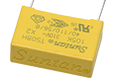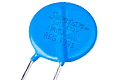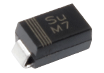


Suntan is a Hong Kong based manufacturer of Trimming Potentiometers, Capacitors, Varistors. It was founded in 1978 and now have 4 factories in mainland China with over 1500 workers. The increasing market demand of our product enable us expand production line continously for wide range of Capacitors, including Tantalum Capacitors, Aluminum Electrolytic Capacitors, Film Capacitors, Ceramic Capacitors, Mica Capacitors, Trimmer Capacitors etc.
Suntan is well established and specializes in service and quality with an extensive export and import network. We provide quick turn around for our customers all over the world. Almost 30 years experience with all types of passive components using good materials, state of the art equipment and technology and ongoing QC coupled with extensive R & D assure our customers of the best quality and on time delivery.
We mainly produce Dipped & SMD Tantalum Capacitors, Aluminum Electrolytic Capacitors with Radial type, Axial type, SMD type, Snap in type, Screw type and LUG type, Radial & SMD Multilayer Ceramic Capacitors, High Voltage Ceramic Capacitor, Axial & Radial Metallized Polyester/ Polypropylene Film Capacitor, Safety Standard recognized capacitor - X2, Y1 & Y2, Ceramic Trimmer Capacitor- 3mm, 5mm, 6mm, 7mm, Silver Mica Capacitors, Gold Capacitors, Trimming Potentiometers, Dipped & Chip Varistor and SMD rectifier & Diode etc.
History of the Capacitors
The invention of the capacitor varies somewhat depending on who you ask. There are records that indicate a German scientist named Ewald Georg von Kleist invented the capacitor in November 1745. Several months later Pieter van Musschenbroek, a Dutch professor at the University of Leyden came up with a very similar device in the form of the Leyden jar, which is typically credited as the first capacitor. Since Kleist didn't have detailed records and notes, nor the popularity of his Dutch counterpart, he's often overlooked as a contributor to the capacitor's evolution. However, over the years, both have been given equal credit as it was established that their research was independent of each other and merely a scientific coincidence.
What is capacitor?
A capacitor or condenser is a passive electronic component consisting of a pair of conductors separated by a dielectric. When a voltage potential difference occurs between the conductors, an electric field occurs in the insulator. This field can be used to store energy, to resonate with a signal, or to link electrical and mechanical forces. Capacitors are manufactured as electronic components for use in electrical circuits, but any two conductors linked by an electric field also display the fundamental property of capacitance. The effect is greatest between wide, flat, parallel, narrowly separated conductors.
An ideal capacitor is characterized by a single constant value, capacitance, the ratio of the amount of charge in each conductor to the potential difference between them. The unit of capacitance is thus coulombs per volt, or farads. Higher capacitance indicates that more charge may be stored at a given voltage. In practice, the insulator allows a small amount of current through, called leakage current, the conductors add an additional series resistance (specifically called equivalent series resistance), and the insulator has an electric field strength limit resulting in a breakdown voltage.
The properties of capacitors in a circuit may determine the resonant frequency and quality factor of a resonant circuit, power dissipation and operating frequency in a digital logic circuit, energy capacity in a high-power system, and many other important aspects.
The capacitor was discovered in 1745 as the Leyden jar and has become ubiquitous within electronic and electrical systems. Electrolytic capacitors and supercapacitors are used to store small and larger amounts of energy, respectively, ceramic capacitors are often used in resonators, and parasitic capacitance occurs in circuits wherever the simple conductor-insulator-conductor sequence is formed unintentionally.
How Capacitors Work
In a way, a capacitor is a little like a battery. Although they work in completely different ways, capacitors and batteries both store electrical energy. Inside the battery, chemical reactions produce electrons on one terminal and absorb electrons on the other terminal. A capacitor is much simpler than a battery, as it can't produce new electrons -- it only stores them.
In this article, we'll learn exactly what a capacitor is, what it does and how it's used in electronics. We'll also look at the history of the capacitor and how several people helped shape its progress.
Inside the capacitor, the terminals connect to two metal plates separated by a non-conducting substance, or dielectric. You can easily make a capacitor from two pieces of aluminum foil and a piece of paper. It won't be a particularly good capacitor in terms of its storage capacity, but it will work.
In theory, the dielectric can be any non-conductive substance. However, for practical applications, specific materials are used that best suit the capacitor's function. Mica, ceramic, cellulose, porcelain, Mylar, Teflon and even air are some of the non-conductive materials used. The dielectric dictates what kind of capacitor it is and for what it is best suited. Depending on the size and type of dielectric, some capacitors are better for high frequency uses, while some are better for high voltage applications. Capacitors can be manufactured to serve any purpose, from the smallest plastic capacitor in your calculator, to an ultra capacitor that can power a commuter bus. NASA uses glass capacitors to help wake up the space shuttle's circuitry and help deploy space probes. Here are some of the various types of capacitors and how they are used.
Car Audio Capacitors
The audio system in our cars is an assortment of different parts. Each and every part in the system performs a specific function. It is with the co-ordination of all the parts, that you can hear the system play those fantastic tracks as you drive along. In the entire system, car audio capacitors have a significance of their own.
What are car audio capacitors?
Car audio capacitors are basically power storages in the car. These capacitors accumulate that power which is essential for the amplifier to produce great sounds. You can hear the booming bass sounds and songs with that much needed punch only because of audio capacitors. Car audio capacitors are also known as stiffening capacitors.
More on car audio capacitors
Audio capacitors accumulate power whenever it is not required. This power is released when the demand for power exceeds the supply capacity of the power system of the car. Audio capacitors are necessary to supplement the regular power supply of the car in order to ensure the smooth functioning of the amplifier. Car audio capacitors usually range from 0.5 farads to 3 farads.
You have to install a car audio capacitor that complements your amplifier. It is also necessary to place the capacitor as near as possible to the amplifier. For 500 RMS of power output, it is necessary to have an audio capacitor of 0.5 farads.
There are also digital audio power capacitors. These can also be installed in cars. A digital audio capacitor (usually from 1.5 farads) consists of a turn on and turn off circuitry along with a 24-volt DC.
If you car lights dim when your car audio system produces a deep bass note, then your amp will be greatly helped with a car audio capacitor.